When you step on the scale, what goes through your mind? For many people, the number looking back isn’t just data—it’s a judgment. It becomes a verdict on whether you’re “good” or “bad,” “successful” or “failing.” And here’s the truth I want you to hear: your self-esteem is directly linked to your scale, and your scale is directly linked to your self-esteem.
But this isn’t just about pounds or numbers. It’s about the dialogue you have with yourself every single day.
The Power of Self-Talk

Most of us underestimate how powerful our words are—especially the ones we say quietly to ourselves.
- Every time you sigh at your reflection, you chip away at your confidence.
- Every time you apologize unnecessarily (“Sorry I look like this today” or “Sorry I ate that”), you reinforce shame.
- Every time you call yourself “lazy” or “weak,” you’re programming your brain to believe it.
This erosion of self-esteem doesn’t just affect how you feel—it directly impacts your weight loss journey. Why? Because when you don’t believe in yourself, you’re less likely to follow through, less likely to make empowered choices, and more likely to turn to food for comfort.
The Self-Esteem / Scale Loop
Think of it like a feedback loop:
- Negative self-talk → lowered self-esteem.
- Lowered self-esteem → diminished motivation and energy.
- Diminished motivation → choices that don’t align with your goals.
- Those choices → reflected back at you on the scale.
- The scale’s result → fuels more negative self-talk.
And so, the cycle repeats.
But here’s the good news: you have the power to break that cycle.
Flipping the Script

Imagine if you treated yourself the way you would treat a close friend who’s working toward a goal: with patience, encouragement, and compassion. That kind of self-talk builds self-esteem instead of tearing it down.
Here are three practical shifts you can make today:
- Catch yourself apologizing.
Stop saying “sorry” for existing, for taking up space, or for making choices. Replace “sorry” with “thank you.”- Instead of “Sorry I’m late,” try “Thank you for waiting.”
- Insert gratitude. Instead of “Sorry I have been out of touch,” try “So grateful we are connecting.”
- Reframe setbacks as feedback.
The scale doesn’t define your worth—it’s simply data. If the number doesn’t move the way you hoped, ask: What can I learn from this? instead of What’s wrong with me? - Build your self-esteem bank account.
Each positive word you speak to yourself is like a deposit. Each cruel word is a withdrawal. Make more deposits than withdrawals, and watch your balance grow.
Your Weight Loss is About More Than Weight
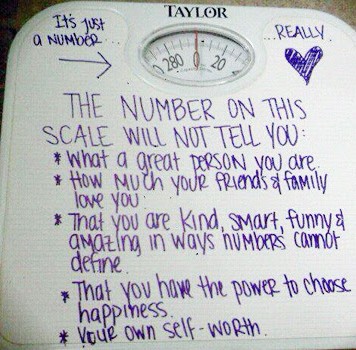
Sustainable weight loss is not just a physical transformation—it’s an emotional and mental one. The stronger your self-esteem, the steadier your choices, and the more consistent your progress. When you stop eroding yourself with negative self-talk, you’ll discover the scale no longer has the power to control your mood, your day, or your self-worth.
Remember: the way you speak to yourself is the loudest nutrition you’ll ever consume.
Takeaway:
Your self-esteem and your scale are connected—but you are the one holding the key to that connection. Nurture your confidence, protect your self-talk, and you’ll find that your journey to health becomes lighter in every way.