If you’ve ever felt stuck in a cycle of poor eating, low energy, or weight gain—despite your best intentions—there’s a good chance bad habits are to blame. Bad Habits are not just innocent routines. Bad habits silently chip away at your metabolic health, one unconscious loop at a time.
The key to breaking free? You need to understand how habits actually work.
Every habit—especially the ones sabotaging your health—follows the same 4-step cycle:
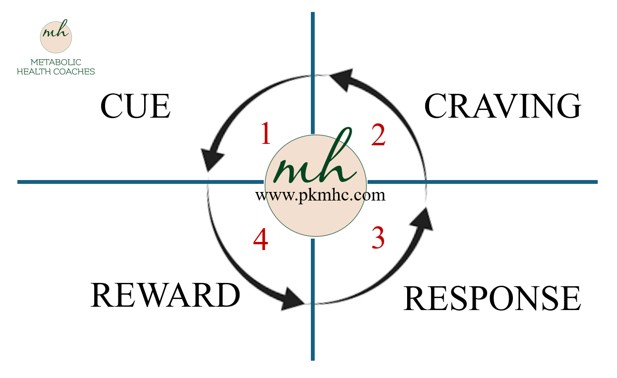
As we begin to dig in, please note that we are talking about CHANGING A HABIT, which is often times easier than CREATING A NEW HABIT. Often, people mistake “Will Power” with what it takes to either change or start a habit…to stop a bad behavior, or to start a positive behavior. In fact, will power is often times the “weakest” part of the equation.
Will power carries with it history, emotion, sentimental value, pressure to be perfect, and often times will power is associated with an either/or outcome of ALL WIN…..OR ALL LOSE.
Outcomes should be viewed as sources of feedback, and create an information loop rather than a behavior loop.
Will Power lives in Quadrants 2 and 3 in the graphic, and once you enter either quadrant, the result most of the times is a METABOLIC MUDSLIDE.
Logically, to change a habit, it makes sense to avoid Will Power, and go to the objective starting point….the CUE that triggers the entire event and puts everything in motion.
Step 1: CUE – The Trigger That Starts It All

Bad habits begin with a cue—something in your environment, schedule, or emotions that signals your brain to go into autopilot.
For example:
Going to a movie? That’s a cue.
Getting bored mid-afternoon? Another cue.
Feeling stressed after work? Cue again.
These triggers often happen without you even noticing—but they set everything in motion.
Step 2: CRAVING – The Desire That Follows

Once the cue hits, your brain quickly creates a craving. And it’s not just for food—it’s for the feeling that food gives you.
You don’t just want popcorn—you crave the comfort, crunch, or pleasure it brings.
You don’t just want sugar—you crave the quick energy or distraction from stress.
Cravings are the emotional fuel behind the habit.
Step 3: RESPONSE – The Action You Take

This is when the habit shows up. You follow the craving with a response—usually on autopilot.
In the movie example:
You walk to the concession stand.
You buy the popcorn.
You eat it—even if you’re not really hungry. This becomes your go-to behavior, reinforced every time you follow through.
Step 4: REWARD – The Reinforcement That Locks It In

The final step is the reward. Your brain gets a hit of satisfaction—pleasure, distraction, comfort—and locks the habit in as a solution.
Here’s the twist: that reward strengthens the original cue.
Next time you go to the movies, your brain expects popcorn.
Next time you’re bored or stressed, it craves sugar or snacks.
This loop creates a metabolic trap—repeated behaviors that spike blood sugar, slow your metabolism, and drain your energy. And it all feels automatic.
The Good News? Awareness Breaks the Cycle
You don’t need willpower—you need awareness. The moment you recognize your cues, you can interrupt the loop and make a better choice. Over time, new habits can replace the old ones—with better metabolic outcomes.
Try This Today:
- Identify one common cue that leads to a bad habit (like the movie-popcorn example).
- Ask yourself: What am I really craving?
- Choose a different response—one that supports your health rather than harms it. ( HINT: Free Consult with a Metabolic Coach)
Celebrate the small win to create a new, positive reward. Follow through the decision to create new habits by enlisting the help of a metabolic health coach, certified in health, nutrition and habits as they relate to metabolism.
Metabolic health doesn’t change overnight. But when you start rewiring just one habit loop, you take back control of your energy, your choices—and your life